

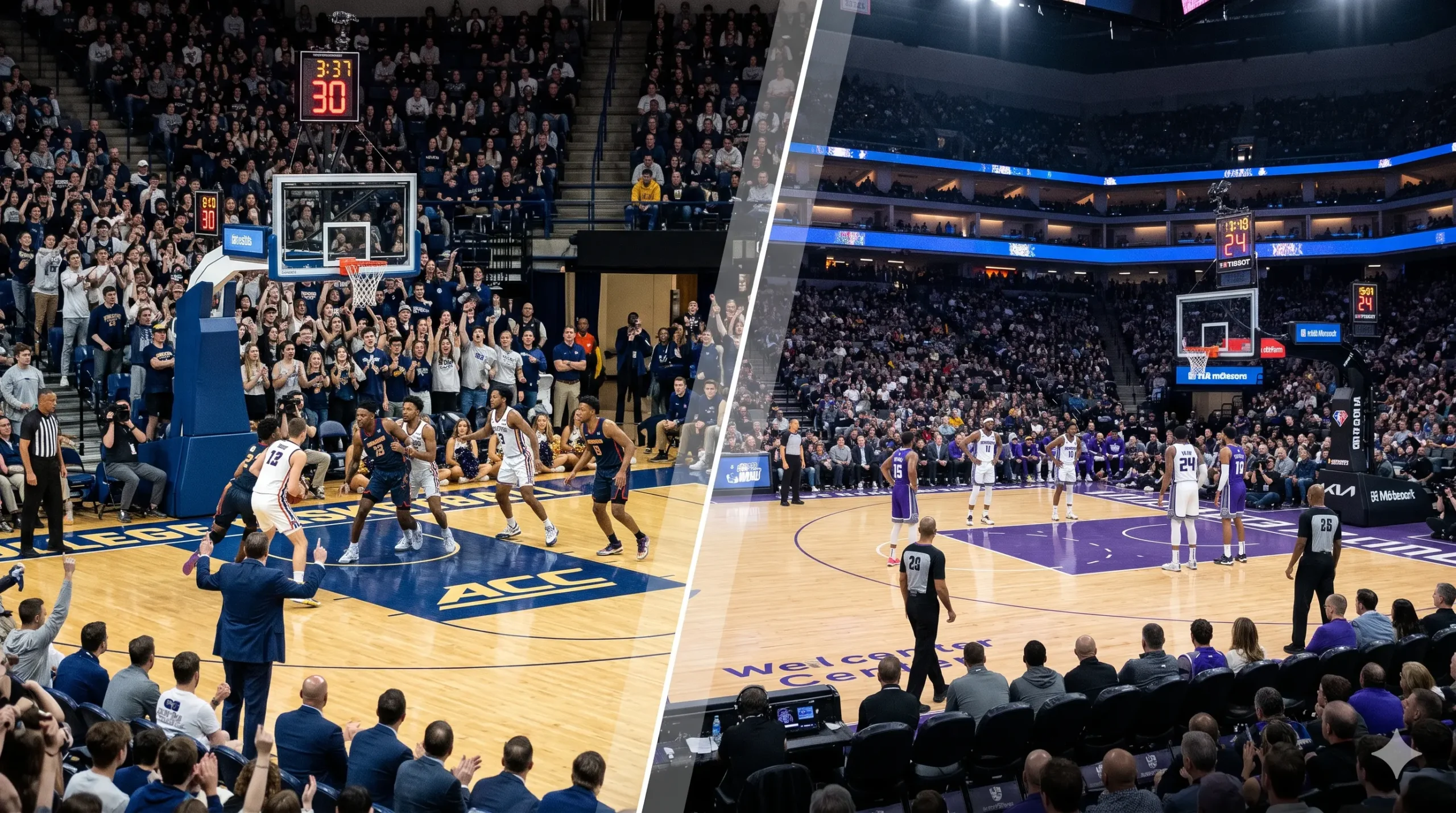
While the core objective of basketball remains identical from campus arenas to professional stadiums, the rulebook undergoes major shifts as players move from the amateur to the professional ranks. From the length of the shot clock to the distance of the three-point line, understanding the key differences between NCAA, NBA, and WNBA rules offers deeper insight into how the game is played, paced, and officiated at each level.
Every year, millions of Americans tune into March Madness and the NBA Finals, often noticing subtle differences in how games flow and how referees blow the whistle. Many fans incorrectly assume college basketball operates under a single set of unified rules. In reality, evaluating the differences requires splitting the comparisons into men’s rules (NCAA Men vs. NBA) and women’s rules (NCAA Women vs. WNBA).
Whether you are a casual viewer trying to understand a confusing late-game foul or a bettor analyzing scoring totals, here is a comprehensive breakdown of the key structural differences defining American basketball.
Timing, Game Length, and the Shot Clock
The pace of a basketball game is directly dictated by its timing structure, which varies significantly depending on the league and gender.
- Game Length: NBA games are the longest in the sport, consisting of four 12-minute quarters for a total of 48 regulation minutes. In contrast, the WNBA and NCAA women’s basketball both play four 10-minute quarters, totaling 40 minutes of regulation play. NCAA men’s basketball is the traditional outlier, uniquely utilizing two 20-minute halves instead of four quarters.
- The Shot Clock: Professional leagues demand a faster, more urgent pace. Both the NBA and WNBA use a 24-second shot clock. At the college level, both NCAA men’s and women’s teams operate with a longer 30-second shot clock. This extra six seconds allows college coaches to implement complex motion offenses, whereas professional teams rely more heavily on quick pick-and-roll or isolation plays.
- Advancing the Ball: In the NBA and WNBA, an offensive team has exactly 8 seconds to advance the ball past the half-court line. In the NCAA, teams are granted a slightly more forgiving 10 seconds to cross the timeline before a turnover is called.
Court Dimensions and the Three-Point Line
The physical spacing on the floor changes dramatically between college and the pros, directly impacting offensive schemes, defensive rotations, and scoring opportunities near the rim.
| Feature | NBA | WNBA | NCAA Men | NCAA Women |
|---|---|---|---|---|
| 3-Point Distance (Top of Key) | 23 feet, 9 inches | 22 feet, 1¾ inches | 22 feet, 1¾ inches | 22 feet, 1¾ inches |
| 3-Point Distance (Corners) | 22 feet | 22 feet, 1¾ inches | 22 feet, 1¾ inches | 22 feet, 1¾ inches |
| Lane (Paint) Width | 16 feet | 16 feet | 12 feet | 12 feet |
| Basketball Size | Size 7 (29.5 inches) | Size 6 (28.5 inches) | Size 7 (29.5 inches) | Size 6 (28.5 inches) |
The most consequential dimensional difference is the width of the painted lane. The wider 16-foot lane in the NBA and WNBA forces post players further away from the basket, naturally opening up driving lanes for athletic guards. The narrower 12-foot lane in the NCAA allows interior defenders to play closer to the rim, which often leads to more congested, physical interior play.
Additionally, the NBA features a “restricted area” arc extending four feet from the center of the basket. If a defender is standing inside this arc, they generally cannot draw a charging foul. The NCAA also features a restricted area arc, but it is slightly smaller, measuring three feet from the basket.
Player Eligibility and Draft Rules
The rules governing who can actually step onto the court differ massively, creating distinct developmental timelines for athletes.
In men’s basketball, the NBA requires draft entrants to be at least 19 years old during the calendar year of the draft and at least one year removed from the graduation of their high school class. This policy created the famous “one-and-done” era, where elite athletes play a single season of college basketball before turning pro. Evaluating how an 18-year-old navigates the cramped NCAA spacing is a critical challenge when scouting NBA draft prospects coming from college programs.
The WNBA maintains much stricter eligibility rules. To enter the WNBA draft, a domestic player must be at least 22 years old during the calendar year of the draft, or they must have graduated from a four-year university, or their original college class must have graduated. This ensures that women’s college basketball routinely features older, more developed rosters with established superstars playing out three or four full collegiate seasons.
Foul Limits and the Bonus Penalty
Foul management is one of the most critical strategic differences a coach must navigate when transitioning between college and professional basketball.
In the NBA and WNBA, players are allowed six personal fouls before they “foul out” and are disqualified from the game. Because college games are shorter in overall duration (40 minutes total), the NCAA limits both men and women to just five personal fouls per game. This lower threshold frequently forces college coaches to bench their star players early in the first half if they pick up two quick fouls.
The team foul penalty—commonly referred to as “the bonus”—also differs drastically:
- NBA, WNBA, and NCAA Women: Because these games are played in quarters, the team foul count resets at the beginning of every period. A team shoots two guaranteed free throws for every defensive foul starting with the 5th team foul of the quarter.
- NCAA Men: Because they play in two halves, the NCAA men’s game utilizes a unique escalating bonus structure. Starting on the 7th team foul of the half, the fouled player enters the “one-and-one” scenario (they must successfully make the first free throw in order to earn the second attempt). It is not until the 10th team foul of the half that they enter the “double bonus” and are guaranteed two free throws.
Timeouts and Advancing the Ball
Late-game situations highlight major discrepancies in timeout rules. In the NBA and WNBA, if a team calls a timeout in the final two minutes of the fourth quarter or overtime, they are granted the option to “advance” the ball. This means they can take the ball out of bounds at the 28-foot mark in the frontcourt rather than passing it all the way up from under their own basket.
The NCAA does not allow teams to advance the ball using a timeout. Regardless of the game clock, a college team must inbound the ball from the spot of the stoppage, forcing them to navigate full-court defensive pressure in the closing seconds of a tight game.
Jump Balls and Possession Rules
Every basketball game begins with a tip-off at center court. However, how referees handle tied-up possessions (when two opposing players grab the ball simultaneously and wrestle for control) depends entirely on the league.
In the NBA and WNBA, a held ball results in a traditional jump ball. The two involved players will line up at the nearest free-throw circle (or center court) and jump for the ball just like the start of the game.
In the NCAA, jump balls are only used to start the game and to begin any overtime periods. For all other held balls during the flow of the game, college officials use the alternating possession arrow. This rule awards the ball out of bounds to whichever team is next in line based on a directional arrow kept at the scorer’s table, eliminating the physical jump ball from mid-game tie-ups.
Related Articles
- Explore the fundamentals of the professional league: What is the NBA in Basketball?
- Understand how officiating is managed at the pro level: NBA Coach Challenge Rules.
- Get ready for the upcoming professional season: NBA 2026-27 Season Opener, Schedule, and Title Contenders.
Frequently Asked Questions
Can you play a zone defense in the NBA?
Yes, zone defense has been legal in the NBA since the 2001-02 season. However, the NBA strictly enforces a “defensive three-second” violation, which penalizes defenders for standing in the paint for three consecutive seconds without actively guarding an opponent. The NCAA does not have a defensive three-second rule. This absence allows college teams to play tightly packed, stationary zone defenses that are much more common and effective at the collegiate level.
What is the overtime rule in the NBA vs. NCAA?
Overtime rules are identical across both major levels of the sport. The NBA, WNBA, and all NCAA divisions use a 5-minute overtime period. If the score remains tied after the first overtime, teams will continue to play 5-minute periods until a winner is decided. There are no tie games in American basketball.
Are NCAA women’s basketballs the same size as the WNBA?
Yes, both NCAA women’s basketball and the WNBA use a standard Size 6 basketball, which measures 28.5 inches in circumference. NCAA men and the NBA use a larger standard Size 7 basketball, which measures 29.5 inches in circumference.
Sources and References
- NCAA: 2026-27 NCAA/NFHS Major Basketball Rules Differences (Undated; accessed November 2026)
- NBA: Official Rules of the National Basketball Association (Undated; accessed November 2026)
- WNBA: Official WNBA Rulebook (Undated; accessed November 2026)


