

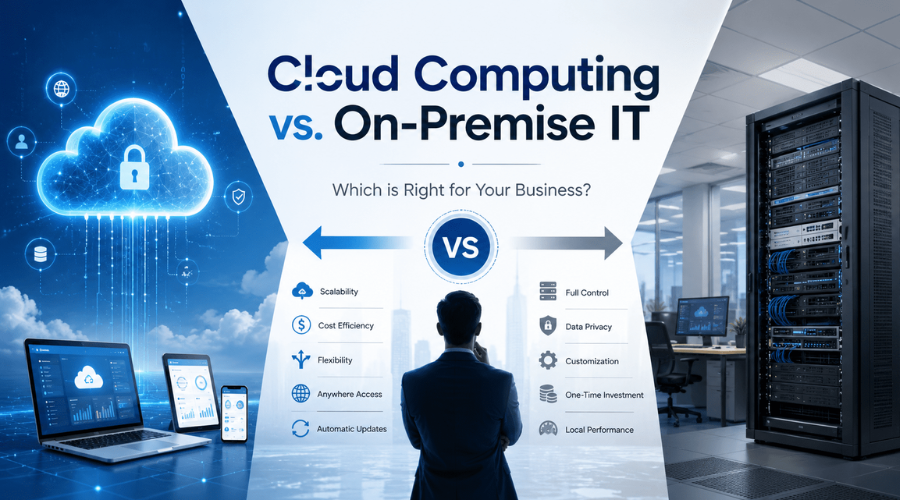
Businesses nowadays have way too many important decisions to make. As the digital transformation overtakes them and their companies, one of the biggest decisions they need to make is whether to use cloud computing or maintain a more on-premise traditional approach.
Cloud computing has improved functions and operations in the last decade but on-premise is still a very important tool even today.
However, deciding between cloud computing vs on premise in 2026 depends more on what your business needs.
Understanding cloud computing vs on-premise in 2026:
What is cloud computing?
Cloud computing is basically a one-stop-software that allows businesses to access their servers, storage, databases and networking over the internet.
So you do not own any “physical” infrastructure over the internet but instead rent resources from cloud providers and just pay them. Some examples of successful cloud providers are –
- Amazon Web Services
- Microsoft Azure
- Google Cloud Platform
In fact, one of the biggest debates has been about choosing between aws vs azure vs google cloud in 2026 because the competition is just that high.
What is on-premise infrastructure?
On-premise infrastructure is the opposite – it is when businesses own a physical server, its networking equipment, storage systems and software inside the company’s facilities.
So, your CPU is an on-premise infrastructure while Google Cloud is a part of cloud computing.
Organisations have the full control over hardware, security policies, data storage, system maintenance and do not have to “pay rent” for it usually.
Key Differences: Cloud computing vs On-Premise in 2026
The discussion around cloud computing vs on-premise in 2026 comes down to these key factors:
Initial costs
Cloud solutions are generally cheaper in terms of the upfront investment that is needed because you do not go out and buy expensive hardware, hard disks, infrastructure and everything else that is needed.
Whereas for on-premises, you need to pay for servers, data centre equipment, installation costs, maintenance expenses and any other miscellaneous costs.
Scalability:
Cloud computing is definitely more scalable – and that too easily.
Any business can increase or decrease the resources it needs based on just demand. They do not need to think about “hardware” they own.
It is one of the biggest cloud migration benefits of 2026 that businesses are exploring and liking.
For the on-premise systems, you need to think about purchasing or selling before you think about expanding your horizon.
Maintenance & Updates
The cloud providers take the responsibility of hardware maintenance, security updates, system upgrades and infrastructure monitoring.
The on-premise environment is such that you needIT teams and professionals to handle it on site.
Security and compliance;
Businesses spend billions in cybersecurity infrastructure and ensuring their systems and therefore their client’s data are safe. But, because hacks are possible – many businesses prefer to keep a lot of important files in the on-premise systems.
Law firms, hospitals, governments and finance institutions follow this where they keep their important documents in both systems. It is one of the biggest debates while choosing between aws vs azure vs cloud computing in 2026.
But if needed – they would choose on-premise over cloud computing.
What are the benefits of Cloud Migration in 2026?
Reduced capital expenditure:
Businesses avoid large upfront hardware purchases especially if they are just starting out so they like to operate through cloud computing and their subscription-based pricing instead – just until they can invest in hardware as well.
Improved flexibility:
You can easily access, store and find files or information instead of going through multiple boxes of paper to find one or two lines.
Fast innovation:
Cloud platforms actually give more access to advanced technologies that help a business. It is one of the biggest cloud migration benefits in 2026 because they make digital transformations very easy.
Such as:
- Artificial intelligence
- Machine learning
- Data analytics
- Automation tools
- Serverless computing
AWS vs AZURE vs Google Cloud in 2026
| Feature | AWS | Azure | Google Cloud |
| Market position | Largest cloud provider | Strong enterprise presence | Growing in AI and analytics |
| Key strengths | Extensive global infrastructure and portfolio | Seamless Microsoft integration and hybrid cloud support | Advanced AI, machine learning, data analytics |
| Best for | Startups, tech companies, advanced cloud workloads | Enterprises already using Microsoft products | Data intensive and AI driven workloads |
| Security | Robust security | Strong security | Comprehensive security with focus on cloud native environment |
Why are on-premise systems still chosen so widely?
- Organisations have direct control over their own data and can physically see it stored
- Some applications are difficult/expensive to migrate
- Businesses that are established may find this more cost effective and easy
Which option is the best for small businesses?
For smaller businesses, cloud computing is definitely better because the debate between cloud computing vs on-premise in 2026 is better for businesses that are already established.
As a new company – cloud computing will be slightly cheaper and easier to manage.
Moreover, it also has lower upfront cost and scalability – both of which are the top priorities of multiple businesses.
You also do not need to worry about updates, security, maintenance on the hardware and more because it is managed by the parent company instead.
However, it also depends on your organisation’s goals. For some, hybrid cloud computing works well because it combines the best of both worlds.


