

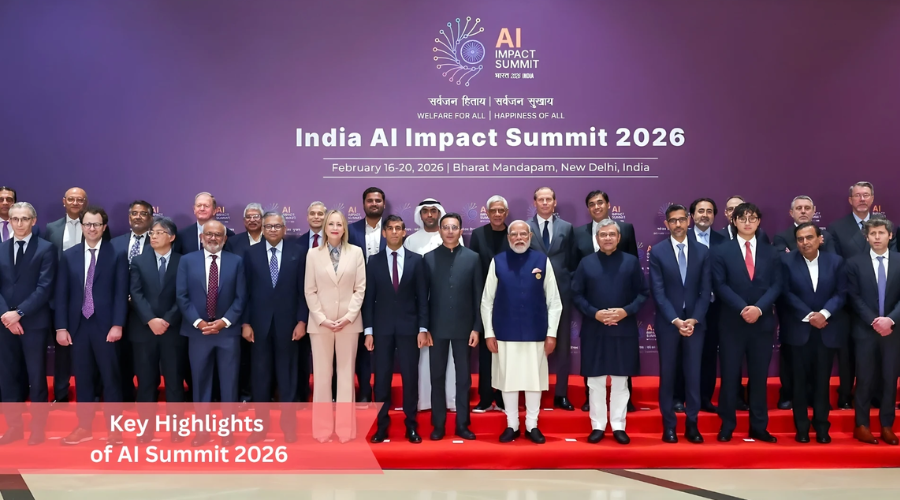
The Indian AI Impact Summit of 2026 was a major turning point for India’s technological ecosystem and a way for the world to view just how advanced India has become as well.
The India AI Impact Summit 2026 showcased India’s growing influence in shaping the future of artificial intelligence worldwide.
It was held in New Delhi and organised under the IndiaAI Mission. It brought the leaders, policymakers, AI companies, startups, founders, researchers, scientists and the most interestingly intellectual people of the world, all under one roof.
Imagine a room filled with the most powerful and intelligent people discussing the future of artificial intelligence in India and across the globe.
Why was this India AI Summit different?
What made this Summit different was how structurally India focused on how to use AI for development and betterment instead of only focusing on AI safety which is how most of these conferences are bound to go.
India proposes and positioned itself as a country that would like to use the development of AI for public services, agriculture, healthcare, education, governance and even job creation but at a much larger scale.
What truly set the India AI Impact Summit 2026 apart was its development-first approach rather than fear-driven AI discussions.
India as the AI hub of the global south
One of the strongest themes at the India AI Summit of 2026 was how India wants to become a global AI leader for all emerging economies. In fact, the government officials kept highlighting the strengths that India possesses which can easily make it the next AI hub:
- India has a massive youth population that is connected to and understands AI well.
- The infrastructure has been growing digitally, supporting the youth
- The startup system has expanded as well
- The engineering workforce is extremely high in India
India also focused on introducing the idea of “People, Planet and Progress” in order to focus more on inclusive and responsible innovation which can make human lives comfortable and easier.
At the India AI Impact Summit 2026, India clearly positioned itself as the AI voice of emerging economies.
More than 100 countries participated in these discussions around global AI controls, governance and what it means to be “developed” in terms of artificial intelligence.
This AI Summit also allowed India’s startup culture to fitness, perform and network with some of the smartest minds in the room. They attracted:
- AI investments
- Research partnerships
- Conversations around data centre expansion
- Semiconductor manufacturing
- Global AI collaborations
How the summit helped Indian AI startups
Currently, there are hundreds of AI startups in India that are actively trying to bring advancements and develop areas like healthcare, agriculture, education, financial institutions, governance systems and more.
So, India’s new repository called “India’s AI Impact Startups” highlighted all of them and how they are building population-scale AI solutions.
The India AI Impact Summit 2026 played a crucial role in giving Indian AI startups global visibility and credibility.
Previously, Indian startups usually copied global SaaS models. But the reason why this Summit was important was because it showed a shift towards:
- Indian-language AI instead
- Voice AI
- Rural AI applications and how to make their lives better
- AI-powered governance systems
For example: Gnani.in demonstrated how they are planning to embrace a multilingual voice AI solution that will help Indian users and public sector applications together.
How does this affect the AI job market?
Naturally, when we talk about AI taking over the world, the first conversation is always about jobs. Who will lose how many? Is it really necessary? How do we manage this?
In the summit, executives and policy makers acknowledged this fact and that AI will automate a lot of repetitive tasks that currently humans are doing, such as:
- Basic coding
- Data processing
- Back-office operations
- Routine customer support
- Low-level analytics work
But they also mentioned that this will also create new jobs and openings in these fields:
- AI literacy
- Domain expertise
- Product thinking
- Problem solving abilities
- Human-AI collaboration skills
As millions of engineers enter the Indian workspace, it is important to help them figure out how they can fiscally support themselves after years of studying. So, companies are hiring more professionals who understand both technology and business operations now.
How does Reskilling help with the job search?
A major takeaway from this Summit was how important it is to re-skill the workforce if India wants to become an AI superpower.
Currently, only a very small portion of India’s tech workforce has strong AI skills and with companies investing so much in internal AI training – India needs to also focus on AI training from a younger age.
They could make changes to their educational curriculum where introduction to AI is taught to kids from a young age so by the time they enter the workforce, they are already knowledgeable about it.
IBM also announced that they will make efforts to skill millions of Indians in AI, cybersecurity and emerging technologies.
And if you think AI is all about coding only – it is not.
It is also about:
- Prompt engineering
- AI operations
- AI ethics
- Data governance
- AI product management
- Industry-specific AI implementation
India’s investment in the AI infrastructure
One thing that the India AI Summit of 2026 confirmed was that India is now investing a lot into the AI infrastructure so that they can lead in AI development as well.
They discussed the expansion of GPU access and expanding the national computer infrastructure to further strengthen artificial intelligence in the country.
The government is also funding research into AI fields like semiconductor ecosystem development and more.
AI governance and responsible AI were central themes:
The summit, while focused on progressing AI, also acknowledged the fact that AI can be dangerous in a lot of ways. So naturally, governance and responsibility were two major topics.
India pushed for inclusive AI access so that they can build safer AI systems while maintaining international cooperation.
They also focused on fair AI regulation especially across social media platforms.
The India AI Impact Summit 2026 showed that India is no longer a developing nation for AI – but a nation that is heading steadfast into becoming one of the top AI leaders of the world.
Overall, the India AI Impact Summit 2026 proved that India is rapidly transitioning from an AI adopter to a global AI leader.


